An independent look at the casino
CryptoCasino.com casino review
 Available in GB
CryptoCasino.com combines a cryptocurrency-first wallet, conventional slots, streamed dealer tables, proprietary games and a tiered loyalty system. The defining trade-off is that blockchain transfers and token price movements sit alongside ordinary gambling risks.
Section element
Launched in 2024, CryptoCasino.com groups casino games, live tables, Originals and a sportsbook within a wallet-led product. Bitcoin, Ether and stablecoins are part of the funding model; a separate crypto-purchase service serves people converting conventional currency. That distinction affects payment friction, transaction costs and how a balance is measured.
Beyond corporate structure and licensing scope, the practical questions for any account-holder are immediate: which asset and network are being transferred, how the game generates outcomes, when reward credits are released, and what identity checks can interrupt a cash-out.
- Launched2024
- Funding modelCryptocurrency-first wallet
- Game formatsSlots, live tables and Originals
- Support24/7 chat and email
Crypto funding and gambling odds are separate dimensions of loss. A token can fall in market value before a bet begins, while the game's mathematical edge operates on the wager itself. Treating both as one cost can hide where the exposure originates.
The cost of play begins before a bet is settled
A casino session is not defined solely by the result displayed on the game screen. For a crypto-funded balance, network costs and an asset's market movement can change the value of money entering and leaving the gaming account. Once play begins, the rules and volatility of the selected game add a separate layer of uncertainty.
Take a purely illustrative £100 crypto value. A £1 inbound network charge, a 10% adverse price move and a £1 outbound charge would leave £88.10 under a simple transfer-value model, even with no gambling outcome included. Those are sample inputs, not CryptoCasino.com tariffs or a prediction of what any coin will do. Holding a stablecoin may reduce exposure to the particular price movement of a volatile token, but stablecoin redemption, network and counterparty risks remain.
Transfer exposure
A blockchain transaction pays network costs and requires the correct destination. Wrong-chain transfers can be difficult or impossible to reverse, so a mistaken address is unlike an ordinary card-payment correction.
Game mathematics
House edge is a long-run statistical expectation. It does not predict the result of an individual slot spin, a live hand or a short session, where variance can dominate the outcome.
Balance denomination
A figure expressed in crypto units can rise or fall in pound terms without the number of tokens changing. A sterling equivalent is a measurement, not a cash-wallet promise.
For a session budget, it helps to distinguish the intended stake from the value exposed to exchange movement. Repeated bets can produce a total wagering turnover far above the initial wallet transfer, and a positive result on one game does not undo a poor exchange rate or an irreversible transfer mistake.
A crypto wallet and a card-funded purchase take different paths
CryptoCasino.com uses crypto assets for its casino wallet. Its Changelly connection is a separate route for purchasing cryptocurrency with conventional currency, with Visa and Mastercard among the purchase methods described for that service. A card used to buy tokens is not the same as depositing pounds directly into a traditional casino cashier.
Direct blockchain transfer
An existing token balance moves from a personal wallet to the destination address for the selected asset and network. Transfer timing depends on network congestion, confirmations and any subsequent casino processing.
The key checks are the ticker, the chain, the destination address and the transaction's effective cost in the token being sent.
A separate purchase before the transfer
A fiat purchase adds a conversion transaction before the casino receives crypto. Purchase fees, spread, identity checks imposed by the purchase provider and the eventual network transfer are distinct considerations.
Card approval for a crypto purchase does not create a conventional card gaming balance or guarantee that every domestic card works with the on-ramp.
Either path ends in a blockchain balance and the same need to reconcile token units with their conventional-currency equivalent. Card-purchase and wallet-transfer comparisons can therefore be made in three parts: the entry fee, the final amount of crypto received, and the cost of moving it back out. A superficially low purchase fee can be offset by exchange spread; a low-cost blockchain can still be the wrong choice if a receiving wallet does not support that network.
The funding route changes transaction mechanics; it does not change the probability of winning the underlying casino game.
Account convenience comes with possible identity checks
CryptoCasino.com offers conventional username, email and password registration alongside wallet-related options such as MetaMask and WalletConnect. Telegram is also part of its connected experience. These entry points differ in how a person authenticates, but they all lead to an account whose activity may be reviewed under the casino's identity and security rules.
A wallet connection establishes control over a compatible wallet address during an interaction. It does not, by itself, prove a person's legal identity, age or residential address. CryptoCasino.com reserves the ability to request documents such as government ID, a selfie or a recent address record when a security or transaction review requires them. It would therefore be misleading to equate a wallet login with guaranteed anonymity.
- Account access
- Email, username and password; supported wallet integrations and a Telegram-linked route.
- Support channels
- Live chat offered around the clock, with [email protected] as the email route.
- Player protection
- Self-exclusion can be requested through support; the operation of such a request deserves clear written confirmation.
Anyone seeking help with a payment question benefits from keeping a transaction hash, the exact asset/network combination and the account correspondence together. These records distinguish a delayed blockchain confirmation from a balance display problem and allow support to understand which transfer is involved. They also separate the actual transaction history from an automatically rounded value shown on a game interface.
On mobile, the responsive browser interface is the primary format; Telegram adds a linked experience. Device security is as important as ease of login. A compromised handset or an approved malicious wallet signature can cause a different problem from forgetting a casino password, because blockchain transfers may be irreversible.
Wallet choices cover major coins and several blockchain networks
CryptoCasino.com lists BTC, ETH, USDT, USDC, LTC, BCH, DOGE, XRP, TRX, ADA, BNB, SOL, TON and SHIB among its crypto payment assets. This is a broad selection of blockchain families, ranging from Bitcoin's own chain to Ethereum-based tokens and native assets on other networks. Each family has its own address rules and transaction behaviour.
The platform describes a deposit process in which a coin is selected in the wallet area, a transfer address or QR code is presented, and the blockchain transaction requires sufficient network confirmations before crediting. For the actual mechanics, the most consequential distinction is often the network rather than the token symbol alone. USDT, for instance, can exist on more than one chain; an ERC-20 destination and a TRC-20 destination are separate routes.
- Identify the asset being transferred and the destination network together. The token ticker by itself is an incomplete transfer instruction.
- Compare the full destination address and selected chain with the sending wallet's network. A QR code is a convenience, not independent evidence that the target is correct.
- Separate network confirmation time from account balance posting. A transaction hash records blockchain activity even when a casino interface updates later.
- Reconcile the amount sent, the network fee and the number of units received before interpreting a sterling-equivalent balance.

Bitcoin's native network, Ethereum's ERC-20 token system and Tron's TRC-20 tokens are different rails. Choosing between them is not equivalent to changing a display currency in a banking app. Network support must be checked for the particular asset/address combination, and transaction fees change with chain conditions. The crypto payment methods and network breakdown separates ordinary deposits from third-party purchases and explores how a chain mismatch affects settlement.
A receiving address can be mathematically valid yet unsuitable for the intended asset or chain. That is why a successful wallet broadcast is not sufficient proof that funds will arrive in a usable casino balance. The practical safeguard is consistency across the asset, network and destination, with no inference that all coins run over all chains.
Crypto transfer scenario
How much value can a crypto transfer lose?
Model how a change in an asset's price and two network fees affect the sterling value of a hypothetical transfer. All four starting figures are examples you can change, not CryptoCasino.com fees or exchange-rate forecasts.
Illustrative starting amount: £100
−10% is a downside scenario, not a prediction
£1 is an example network cost
£1 is an example network cost
Illustrative value after transfer costs and price movement
Change from start:
Hypothetical value reduction
GBP measures the scenario's value; it is not a claim that the casino operates a GBP cash balance.
How the estimate works
Subtract the chosen inbound network fee from the starting sterling value. Multiply what remains by one plus the hypothetical percentage price change. Subtract the outbound network fee, then use zero as the floor. The difference is the resulting value minus the starting amount.
CryptoCasino.com supports coins including BTC, ETH, USDT and TRX. Transfers involve particular blockchain networks, so fees are entered by the reader; this is not a casino fee schedule. The estimate excludes gambling results, exchange spreads and other charges.
18+ only. Crypto prices can change sharply and blockchain transfers may be irreversible. National Gambling Helpline: 0808 8020 133 (24/7); gamcare.org.uk.
XP, Coins and cashback serve different purposes
CryptoCasino.com's loyalty system uses XP progression, Coins, missions, badges and a rewards store. Higher status can unlock cashback and other tier-specific benefits. These components should be understood separately: an XP level reflects programme progress, Coins function as a store currency under programme rules, and cashback concerns a conditional rebate linked to eligible play or losses.
The published cashback range extends from 2% to 12% by tier, with the upper figure a programme ceiling rather than a uniform return. Suppose, purely as arithmetic, a tier applied 5% cashback to £200 of eligible net loss. The illustrative rebate would be £10, leaving £190 of the loss before considering any additional rules. Cashback does not turn a negative gambling outcome into a profitable strategy, and a headline maximum rate says little about the rate applied to an individual account.
One test catalogued 120 missions, indicating that the programme is broader than a simple deposit rebate. The analytical question is not merely what a mission offers but whether it asks for additional betting turnover, particular game categories or time-limited activity. A reward earned through further spending has a different economic character from a reduction in an existing expense.
Cashback, welcome rewards and Coins also have different accounting conditions. They are best treated as separate ledgers rather than being added together into a single percentage labelled as a benefit. The nominal reward amount is only one side; the associated eligibility, redemption and wagering conditions determine how much value may actually become withdrawable.
Dispute themes and transaction evidence answer different questions
Public player feedback around CryptoCasino.com highlights the gap between rapid wallet-based onboarding and the account checks that can apply when withdrawing funds or claiming staged rewards. Recurring friction points centre on identity verification triggers, bonus-eligibility rules around low-risk betting, turnover thresholds before fee-free withdrawals, and network selection mistakes when transferring tokens.
Individual customer complaints describe varied experiences across cash-outs and account restrictions, making them useful for spotting operational friction while remaining distinct from formal findings of a rule breach. Because crypto transactions split responsibility between the casino's internal ledger and external blockchain networks, two complaints that both mention a delayed balance can stem from completely different stages of the payment path.
| Dispute category | Typical trigger | Key evidence to retain |
|---|---|---|
| Withdrawal hold | Manual security or KYC check up to 24 hours, or unmet deposit turnover | Request timestamp, asset and chain, account status and support replies. |
| Bonus disqualification | Excluded titles, low-risk betting rules or expired instalment windows | Applicable promotional terms, bet history and stake sizes during turnover. |
| Missing transfer | Mismatched token network (such as ERC-20 vs TRC-20) or wallet crediting delay | Destination address, selected network and on-chain transaction hash (TXID). |
Complaint themes should always be read alongside the specific transaction mechanics they concern. A dispute over a bonus instalment rule does not mean blockchain payout rails are slow, and a routine instant withdrawal on one account does not mean larger cash-outs bypass manual security checks. Outcomes depend on the payment network, account history, qualifying play and document verification applied to the individual transfer.
For any disputed transaction, objective records—the on-chain transaction hash, exact wallet address, selected network, timestamps and written support correspondence—provide a far clearer picture than broad generalisations about payout speed.
Slots, live tables and Originals create distinct experiences
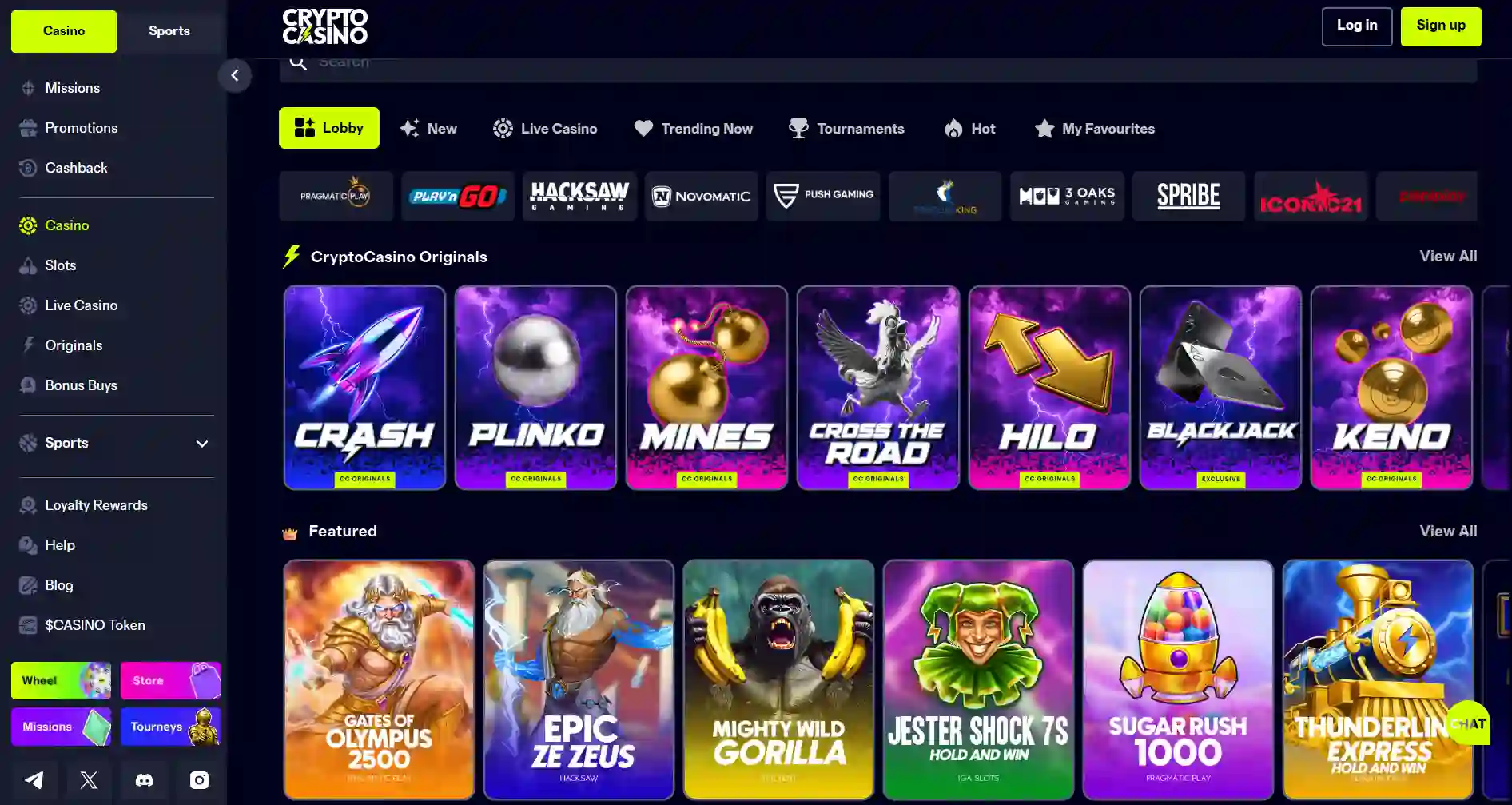
CryptoCasino.com offers conventional slots, RNG-based table games, streamed live roulette, blackjack and baccarat, game shows, crash-style titles and proprietary Originals. The supplier roster includes Pragmatic Play, Play'n GO, Hacksaw Gaming, Novomatic and Evolution. These names describe different game suppliers, so the game mechanics and publisher matter as much as the casino's lobby structure.
The casino lobby spans more than 2,660 games, including over 2,170 slot titles, more than 370 live tables and over 125 casual or crash-style titles across roughly 75 studios. Those figures describe a sampled catalogue at one point in time rather than fixed permanent totals. A large menu gives different types of gameplay, but it is not evidence of a better payout rate for any one title.
| Format | Examples at CryptoCasino.com | Decision factor |
|---|---|---|
| Video slots | Studios including Pragmatic Play, Hacksaw Gaming and Play'n GO | Game-specific paytable, variance and rules affect how results distribute. |
| Live dealer | Roulette, blackjack, baccarat and game shows | Streamed play may have timed decisions and variant-specific rules. |
| Proprietary Originals | Plinko, Gravity Wheel and Stairpong | Some titles provide in-game result verification; it is not a universal feature. |
| Other casino formats | Crash-style and conventional table games | Different session pacing and stake structures change exposure. |
In a live table, the streamed dealer is part of the user experience, while the applicable game rules still determine the odds. A digital slot can produce many rounds in quick succession; that pace changes the number of bets placed over a fixed period. Crash-style mechanics can concentrate attention on a rapidly changing outcome. None of these formats removes the underlying possibility of losing the staked amount.
The casino's Originals form a separate family: Plinko, Gravity Wheel, Stairpong and High Flyer appear within the proprietary Originals lineup. Verification tools on some Originals concern reproducibility of a particular result, not the expectation of profits or the quality of every third-party game.
A fuller game catalogue and live casino breakdown separates supplier-produced slots, dealer-streamed games and proprietary titles. When evaluating a game type, distinguish the interface from the rule set: two visually similar games can follow materially different payout structures, while two games from the same provider need not share a return profile.
The welcome reward unlocks through four wagering stages
CryptoCasino.com's described welcome arrangement includes a 200% first-deposit cash reward with a ceiling of 10,000 USDT, 50 free spins on Wanted Dead or a Wild and a 5 USDT sports-bet component. The casino's ordinary product description places the minimum qualifying first deposit at 20 USDT. The conditions for receiving and releasing reward value matter more than the headline percentage.
The cash reward is separated into four equal instalments. Each next instalment is released after eligible wagering turnover equal to 15 times the first deposit, rather than 15 times the value of an individual reward instalment. If an illustrative deposit were 100 USDT, one release stage would require 1,500 USDT of qualifying stake turnover. Repeating the condition across four stages would involve 6,000 USDT of cumulative eligible turnover if all stages were completed. These are example calculations using the described rule, not recommended betting amounts.
Contribution conditions can also determine which bets count. The operator describes qualifying games and exclusions for certain low-risk or otherwise ineligible play. A third-party terms analysis also cites a maximum €5 or US$5 wager per round during reward clearing. Time-related conditions have been described for the registration, reward and free-spin stages, and should be treated as terms of the specific promotion rather than a permanent general rule.
Four consecutive release gates create a different risk profile from a single cash credit. Even when the first stage is reached, the remaining stages involve additional betting turnover and therefore further game exposure. Details on the welcome bonus wagering and instalment terms explain the release structure separately from ordinary network deposit minimums.
Questions about CryptoCasino.com
Does CryptoCasino.com use a crypto wallet for casino funds?
Yes. CryptoCasino.com is cryptocurrency-first. BTC, ETH, USDT and other listed assets are used through crypto wallet transfers; the card route described for Changelly purchases cryptocurrency before it enters the casino wallet.
Are live dealer games part of the casino catalogue?
Yes. The catalogue includes live roulette, blackjack, baccarat and game shows alongside slots, conventional table games and proprietary Originals.
Does every CryptoCasino.com Original provide provably fair checks?
Some Originals include in-game result verification. The availability of a verifier on one game does not make every Original or third-party title independently reproducible.
Can CryptoCasino.com request identity documents?
Yes. The casino can request identity and address documents during security or withdrawal reviews, even when initial account access uses a wallet connection.
The crypto wallet defines the CryptoCasino.com experience
The game library is broad, spanning familiar studios, live dealers and in-house titles. The loyalty programme adds several distinct reward mechanisms, while staged welcome rewards can multiply the turnover required before release. Yet the primary operational difference is the crypto wallet: the asset and network selected, price changes and irreversible transfers all affect the value of a casino balance independently of gambling outcomes.
Evaluating CryptoCasino.com therefore calls for separating the mechanics of play from the mechanics of funding, and distinguishing conditional reward credits from money already held. That separation gives a clearer account of both potential costs and risks than a headline bonus percentage or game count.